

A missing tooth can change the way you eat, speak, smile, and feel about your appearance. While some people adjust to a missing tooth, leaving a gap untreated may not always be the best long-term choice.
If you are considering dental implants in Port Moody, you may be wondering whether implants are right for you, when you should consider treatment, and what the process involves.
At PoCo Dental Group, we understand that tooth replacement is a personal decision. Our team provides personalized dental care and can help you understand the advantages and limitations of different treatment options before you decide how to proceed. We welcome patients from Port Moody and surrounding communities and provide restorative services including dental implants.
What Is a Dental Implant?
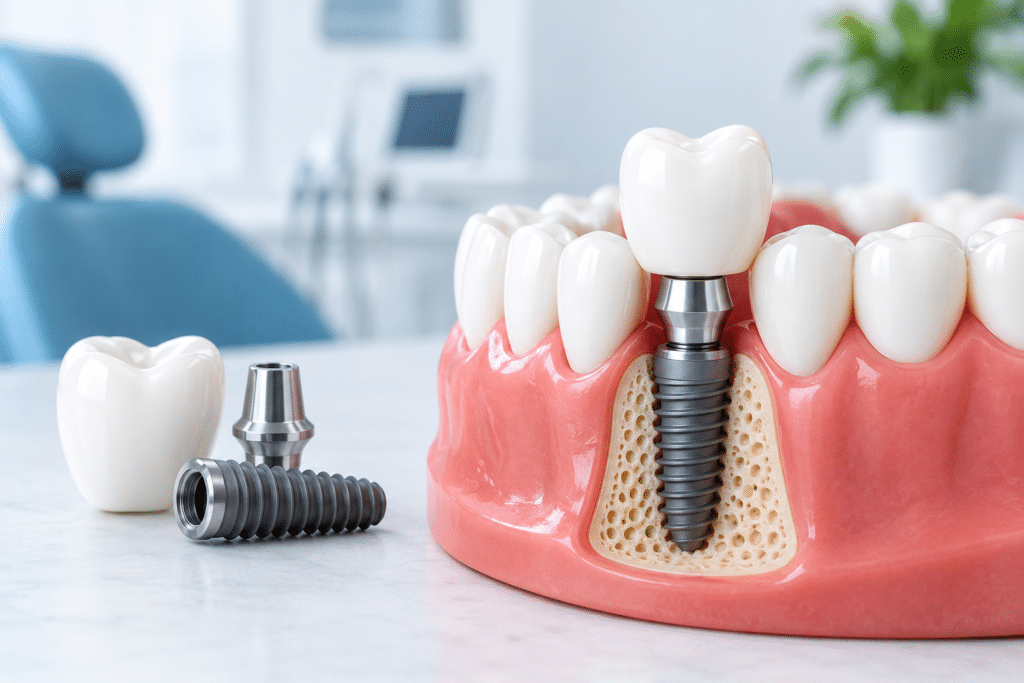
A dental implant is a tooth-replacement solution designed to replace the root portion of a missing tooth.
The implant itself is generally placed into the jawbone. Once the area has healed appropriately, an abutment and replacement tooth can be attached.
This structure is intended to provide a stable foundation for the replacement tooth.
For patients who are missing one or more teeth, dental implants may offer an alternative to traditional bridges or removable dentures.
When Should You Consider Dental Implants?
There is no single age or deadline that determines when someone should receive an implant.
However, there are several situations in which it may be worthwhile to discuss dental implants with your dentist.
You Have Recently Lost a Tooth
If you have recently lost a tooth because of decay, injury, gum disease, or another reason, it is a good idea to discuss replacement options rather than simply leaving the space unattended.
Your dentist can assess the area and explain whether an implant, bridge, denture, or another solution is appropriate.
You Have Been Living With a Missing Tooth
You do not have to replace a missing tooth immediately to ask about dental implants.
Patients sometimes live with missing teeth for years before deciding they want a more permanent tooth-replacement solution.
However, changes can occur in the jaw and surrounding teeth after tooth loss. A dental examination can help determine the current condition of the area and whether additional treatment may be needed before implant placement.
You Are Having Difficulty Chewing
A missing tooth can affect your ability to chew comfortably.
If you have started avoiding certain foods or relying heavily on one side of your mouth, tooth replacement may help restore more balanced function.
You Are Concerned About a Visible Gap
For teeth that are visible when you smile, a missing tooth can have a noticeable effect on appearance.
An implant-supported restoration can be designed to blend with your surrounding teeth, helping restore a more complete smile.
Your Denture Is Uncomfortable
Some patients who currently wear dentures may be interested in implant-supported alternatives.
Implants can sometimes be used to provide additional support for a tooth-replacement restoration, depending on the patient’s oral health and treatment plan.
Also Read: What Is the Cost of Dental Implants
What Are the Benefits of Dental Implants?
Dental implants can offer several potential advantages.
A Stable Tooth-Replacement Option
Because the implant is anchored in the jawbone, the resulting restoration is designed to provide stability.
Natural-Looking Results
The visible crown can be designed to complement the colour, shape, and proportions of the surrounding teeth.
Support for Normal Function
A properly planned restoration can help restore chewing and speaking functions affected by tooth loss.
No Need to Rely on Adjacent Teeth in the Same Way as a Traditional Bridge
A traditional bridge generally uses neighbouring teeth as support. An implant-based restoration has a different structure, as the implant is positioned in the area of the missing tooth.
Long-Term Potential
With appropriate care and maintenance, implants can provide a durable tooth-replacement solution. However, longevity varies and depends on individual oral health, hygiene, habits, and professional care.
Are You a Candidate for Dental Implants?
The answer depends on your individual oral health.
Before recommending implants, your dentist may assess:
- Jawbone condition
- Gum health
- Existing teeth
- Oral hygiene
- Bite and chewing forces
- Medical history
- Smoking or tobacco use
- Location of the missing tooth
- Number of missing teeth
- Your overall treatment goals
Digital dental imaging can be useful when planning implant treatment because it allows the dentist to evaluate structures that cannot be fully assessed during a visual examination. We use digital X-rays for diagnosis and treatment planning, including dental implant cases.
Also Read: What Are the Benefits of Dental Implants?
What If You Do Not Have Enough Bone?
Some patients have experienced bone loss in the area of a missing tooth.
That does not necessarily mean implants are impossible.
Depending on the circumstances, additional procedures may be considered to improve the foundation for an implant. The appropriate approach depends on the amount and location of available bone and your overall treatment plan.
Your dentist can explain whether additional treatment is necessary after reviewing your examination and imaging.
What Is the Dental Implant Process Like?
While each treatment plan is different, implant treatment commonly involves several stages.
Consultation
Your first step is a consultation with a dentist.
We discuss your dental history, examine the area, and talk about your goals.
Diagnostic Imaging
Appropriate imaging can help assess the jawbone and surrounding structures.
Treatment Planning
Your dentist develops a plan based on the number of missing teeth, available bone, gum health, and desired restoration.
Implant Placement
The implant is placed into the jawbone using a carefully planned surgical procedure.
Healing
The implant requires time to heal and integrate with the surrounding bone.
Final Restoration
Once the implant has healed sufficiently, the replacement tooth can be attached.
The complete process may take several months for some patients. The timeline depends on the complexity of treatment and individual healing.
How Do You Care for Dental Implants?
One of the biggest misconceptions about implants is that they do not require maintenance.
They do.
You should continue to:
- Brush your teeth regularly
- Clean between your teeth
- Follow your dentist’s instructions
- Attend regular dental examinations
- Have professional cleanings as recommended
- Avoid habits that could damage the restoration
Keeping the gums around the implant healthy is particularly important.
Dental Implants vs. Dental Bridges
Both implants and bridges can replace missing teeth, but they work differently.
A dental bridge typically spans the space created by a missing tooth and uses neighbouring teeth as support.
A dental implant is placed in the missing-tooth area and can support an individual crown.
Which option makes more sense depends on your oral health, the condition of adjacent teeth, bone availability, personal preferences, treatment timeline, and budget.
Rather than assuming one option is automatically better, discuss both with your dentist.
What If You Have More Than One Missing Tooth?
Dental implants are not limited to single-tooth replacement.
Depending on your needs, implants may be incorporated into treatment for multiple missing teeth.
Your dentist can evaluate whether individual implants, an implant-supported restoration, a bridge, dentures, or another approach is appropriate.
Why Choose PoCo Dental Group for Dental Care Near Port Moody?
Oour team provides comprehensive dental services in a modern and welcoming environment. Our services include preventive, restorative, cosmetic, orthodontic, emergency, and tooth-replacement care.
We understand that patients want more than a technical explanation. They want to know why a particular treatment is being recommended, what alternatives exist, what recovery may involve, and how the treatment can fit their long-term oral health goals.
That is why we focus on personalized treatment planning and clear communication.
Is It Time to Discuss Dental Implants?
You may want to schedule an implant consultation if:
- You have one or more missing teeth
- You recently had a tooth extracted
- You have difficulty chewing
- You are unhappy with a gap in your smile
- Your existing denture is uncomfortable
- You want to explore alternatives to a dental bridge
- You have been told you may need to replace a tooth
- You want to understand your long-term tooth-replacement options
You do not need to decide on treatment before your appointment.
The purpose of a consultation is to understand your situation and learn what options may be available.
Explore Your Dental Implant Options in Port Moody
If you are searching for dental implants in Port Moody, PoCo Dental Group can help you take the next step.
Our team will assess your oral health, discuss your concerns, and explain the tooth-replacement options that may suit your needs. We provide personalized dental care for patients from Port Moody and surrounding communities.
Contact us to schedule an appointment and find out whether dental implants may be right for your smile.
Frequently Asked Questions
1. How soon after losing a tooth should I consider an implant?
It is helpful to discuss replacement options with your dentist relatively soon. The appropriate timing depends on the condition of the extraction site, bone, gums, and surrounding teeth.
2. Are dental implants permanent?
Implants are intended as a long-term tooth-replacement solution, but they require proper oral hygiene and professional maintenance.
3. Can I get an implant if I have gum disease?
Active gum disease may need to be treated before implant placement. Your dentist will evaluate your gums and recommend appropriate care.
4. Can smokers get dental implants?
Smoking can affect oral healing and implant outcomes. Your dentist will discuss the risks and provide recommendations based on your individual circumstances.
5. Will an implant look like my natural tooth?
The replacement crown can be designed to complement your natural teeth in shape, size, and appearance.
6. How long does the entire implant process take?
The timeline varies. Some cases are relatively straightforward, while others require additional procedures and longer healing periods.
7. Can dental implants replace several teeth?
Yes. Depending on your situation, implants can be incorporated into treatment plans for multiple missing teeth.
8. Do implants require special dental appointments?
Regular dental visits remain important. Your dental team can monitor the implant, surrounding gums, restoration, and overall oral health.